
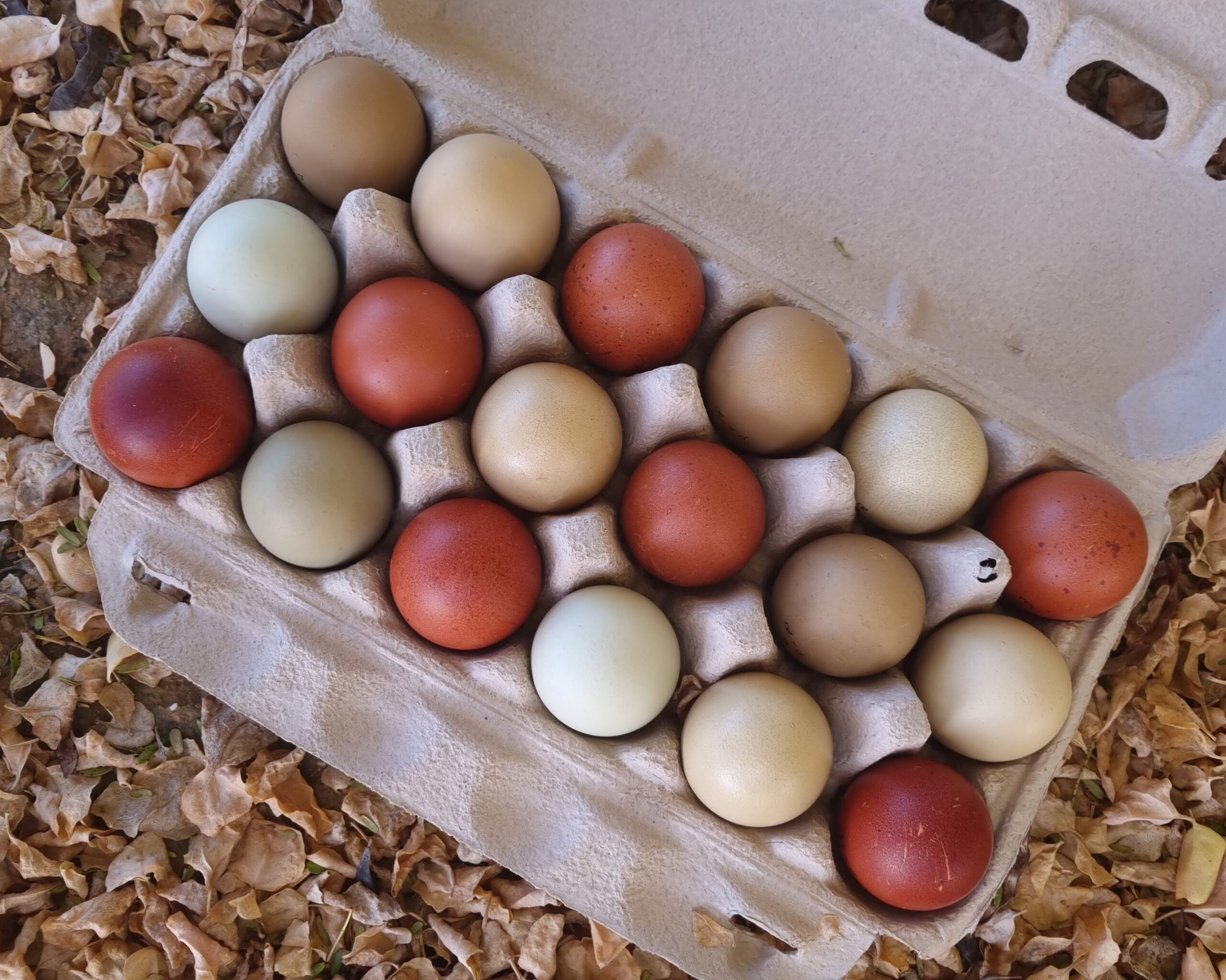
Over the years we have come to understand how the colour, bloom and speckles of an egg laid by the same hen (e.g. Easter Egger, Marans) are not consistent. They vary, influenced by the different factors listed below, and even more.
Egg colour
The colour of an egg is the most intense when a pullet (young hen) just starts laying. That is when the “printer ink cartridge”, so to say, is full. The colour fades as the hen goes through her laying cycle. When she moults (replaces her old feathers with new ones), she gets a break from laying and the cycle resets. When she resumes laying her egg colour will be at its peak again. Note that young pullets are known to often skip the autumn moult.
This is exactly why you can expect to receive less dark/bright eggs later in the year compared to in spring. The egg colour can also be affected during a heatwave.
Egg bloom
The bloom is the protective layer that the hen applies to the egg just before it is laid. Some hens produce an extra-thick bloom, which alters the perceived colour of the egg. It can make green Easter Eggers seem grey, dark brown Marans eggs appear purple, and brown Barnevelder eggs look pink.
Some hens are more consistent in applying a heavy bloom than others. Some will do it once in a while, others to most eggs they lay. You can breed for heavy bloom, in other words, it is heritable, however there’s no guarantee the offspring will in fact inherit it. One can only hope. 🙂
Egg speckles
The speckles on an egg seem to be one of the most variable things that can affect their whole look! For example, we have some F1 Olive Egger hens (Easter Egger x Orpington) that on some days, they’ll lay a plain, green egg. On others, their speckles will be many, very fine ones. And sometimes the speckles get big! They are our favourites. The speckle factor differs between breeds and individuals. Some produce speckles more consistently than others. It seems that, for some reason, we see more speckles pop up during cooler weather. We’re not sure why that is yet.
A word about lighting
The lighting in photo greatly affects how the eggs look. Indoors, outdoors, in the shade, in the sun – they all give very different results. This is why we do our best to show people the colour of our eggs in different lighting conditions. Some breeders enjoy creating really moody photos with low ambient lighting, in which Marans and Olive Egger eggs of course look striking. Just make sure you also see them in brighter lighting, so that you are not disappinted when you order.
Remember this
Although the appearance of a hen’s egg varies throughout the season, the genetics stay the same. When a hen has previously laid rich, dark eggs, and is now laying ones that are a lot lighter in colour because she is close to her first adult molt, those awesome dark egg genetics are still in there! Or when a hen produces an artistically speckled egg one day, but not the next, the non-speckled egg still has value, because it still contains the ability to lay speckled eggs. But if a hen lays light eggs for the first weeks of her egg career, they are not going to suddenly darken/brighten up.
Hope this helps you understand all that affects egg colour a little better. Feel free to pop us a Whatsapp if you have any questions.